
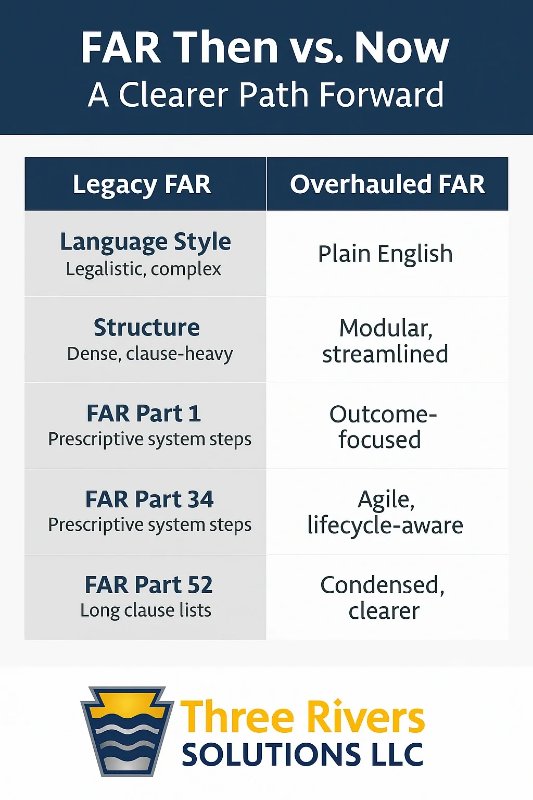
The Trump Administration’s ambitious overhaul of the Federal Acquisition Regulation (FAR) took a major step forward today with the launch of the official FAR Overhaul website, unveiled by the General Services Administration (GSA), Office of Management and Budget (OMB), NASA, and the Department of Defense (DoD).
This site release marks the beginning of the most comprehensive rewrite of the FAR since its creation in 1984, aligning with President Trump’s Executive Order 14099, Restoring Common Sense to Federal Procurement. The order mandates a shift toward plain language, elimination of burdensome non-statutory requirements, and a results-driven acquisition framework.
The overhaul is more than regulatory housekeeping—it is a structural transformation aimed at unlocking innovation, increasing competition, and empowering acquisition professionals across government.
What Was Released Today: A Closer Look at FAR Parts 1, 34, and 52
The newly launched Acquisition.gov FAR Overhaul portal includes draft revisions of three foundational parts of the FAR, now available for public review and comment.
FAR Part 1 – Federal Acquisition Regulation System This section establishes the FAR’s role and authority. The draft rewrite removes legal jargon, emphasizes mission outcomes and taxpayer value, and refocuses the FAR as a strategic tool rather than a compliance document. Definitions have been streamlined and centralized for clarity and consistency.
FAR Part 34 – Major System Acquisition Long seen as rigid and outdated, Part 34 now supports more agile and modular acquisition strategies. The revised draft eliminates duplicative reporting mandates and explicitly recognizes modern approaches like commercial-off-the-shelf (COTS) integration and iterative development cycles.
FAR Part 52 – Solicitation Provisions and Contract Clauses Previously among the most complex sections of the FAR, Part 52 is now more concise and logically structured. Obsolete clauses are eliminated, and formatting improvements make it easier for contracting officers to identify and apply the correct language. This change directly supports faster solicitations and awards.
Each draft includes side-by-side comparisons to the legacy language and clear annotations explaining the rationale for revisions.
A Toolkit, Not Just a Rulebook
In a notable shift, GSA and its partners are releasing non-regulatory Buying Guides alongside the draft FAR parts. These guides provide practical, mission-focused implementation advice without carrying regulatory weight.
This signals a cultural change: instead of writing rules that must cover every contingency, the new FAR framework encourages informed discretion and adaptable practices.
What Comes Next: Timeline, Stakeholder Input, and Finalization
The FAR Council (GSA, DoD, NASA, and OFPP) will release additional parts of the FAR on a rolling basis through 2025 and into early 2026.
For each draft release:
- Stakeholders can review annotated drafts online;
- Public comment periods will be open to industry, federal staff, and associations;
- Listening sessions and webinars will offer additional engagement opportunities.
After public comment, each revised part will go through formal rulemaking. The Administration aims to finalize the full overhaul by the end of FY 2026, with implementation and agency training to follow in FY 2027.
Importantly, the FAR is being restructured for modular, iterative updates—making future changes easier, faster, and more agile.
What This Means for Contractors
Now is the time to engage. This overhaul will reshape federal procurement—both in how contracts are awarded and who is best positioned to compete.
- Small Businesses: Plain language and clause simplification lower entry barriers.
- Established Contractors: Review internal clause libraries, proposal templates, and compliance systems for upcoming shifts.
- All Vendors: Participate in the public comment process to help shape the final rule.
These reforms aim to create a procurement environment that rewards outcomes and value—not red tape.
Congressional Watch: Oversight and Reactions
Although the FAR is an executive branch instrument, Congress—particularly the House Oversight Committee and Senate HSGAC—is likely to monitor implementation closely.
Some early draft provisions, such as the elimination of DEI-related clauses or non-statutory social policy mandates, may prompt oversight hearings or resistance from some lawmakers. So far, support among Congressional Republicans has been strong, while some Democrats have raised early concerns about transparency and accountability.
As the FAR Overhaul unfolds, government buyers and contractors alike must prepare for a new acquisition era—one built on clarity, flexibility, and strategic value.
At Three Rivers Solutions, we are advising clients through this transition and providing actionable insights on adapting to the new rules. This is the most significant change to federal procurement in a generation—understanding it is no longer optional.
Explore the draft FAR text and submit comments at: https://www.acquisition.gov/far-overhaul
Read our original article on the FAR reform initiative: Trump’s 2025 FAR Reform: Boosting Efficiency & Innovation