
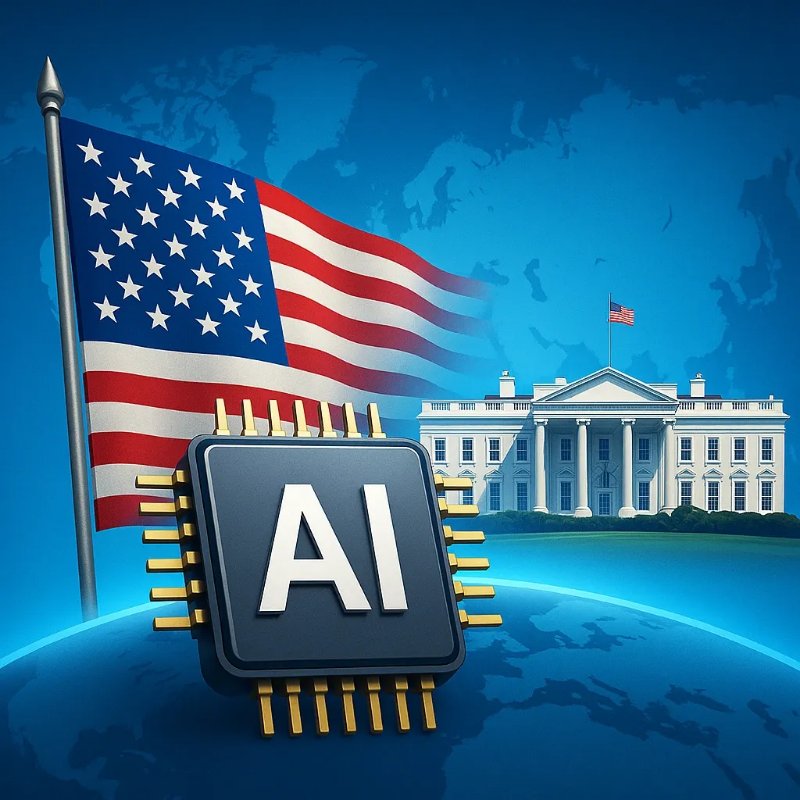
Imagine a world where artificial intelligence reflects American values or one where it enforces authoritarian control. The Trump Administration’s new AI Action Plan makes a clear bet on the former.
On July 23, 2025, the White House released Winning the AI Race: America’s AI Action Plan, a whole-of-government strategy aimed at securing the United States’ global leadership in artificial intelligence. The plan is backed by three Executive Orders that initiate sweeping changes across federal policy, procurement, infrastructure, and diplomacy.
The AI Action Plan reflects a deliberate philosophical shift in Washington. Rather than focusing on regulatory restraint or ethical guardrails, it embraces AI as a national asset, an engine of economic growth, strategic advantage, and geopolitical influence. The plan sends an unambiguous message: the future of AI will be shaped by nations that act, not by those that merely observe.
Why the Administration Is Taking Action
The AI Action Plan responds to a growing consensus that artificial intelligence is no longer an emerging technology. It is a general-purpose technology, meaning a tool with transformative applications across virtually every sector, much like electricity or the internet.
Federal leaders view the stakes as high. They see an urgent need to accelerate the deployment of American-made AI systems that reflect open-market values and constitutional principles. At the same time, global actors are actively promoting centralized and surveillance-enabled models of AI governance. Without action, the Administration warns, the United States could lose influence over the digital standards and ethical foundations that will define the twenty-first century.
At home, structural challenges persist. Permitting delays, outdated procurement rules, and fractured data standards continue to slow innovation. The Action Plan addresses these constraints by removing internal barriers and encouraging American leadership abroad.
A Clear Shift in Philosophy
This urgency has prompted a reorientation of federal AI policy. While the Biden Administration emphasized governance frameworks, such as the 2022 Blueprint for an AI Bill of Rights and Executive Order 14110 on “Safe, Secure, and Trustworthy AI,” the Trump Administration’s approach prioritizes innovation, infrastructure, and national competitiveness.
The 2025 plan is built around three strategic pillars: accelerating AI innovation, building American AI infrastructure, and leading globally in AI diplomacy and security. It outlines more than 90 specific policy actions across the federal government. Unlike prior strategies that offered general principles, this plan focuses on execution and measurable progress.
Executive Orders That Drive Implementation
To implement the Action Plan, President Trump issued three Executive Orders. Each one addresses a core obstacle to U.S. leadership in artificial intelligence.
Accelerating Permitting for AI Infrastructure
The first order directs federal agencies to expedite permitting for large-scale AI infrastructure projects, including data centers, semiconductor fabrication plants, and high-voltage energy systems. Agencies must streamline environmental reviews under the National Environmental Policy Act and identify public lands that are suitable for rapid development. This is intended to meet the growing power and processing demands of modern AI systems.
Promoting the Export of the American AI Technology Stack
The second Executive Order creates the American AI Exports Program. This initiative will offer full-stack AI solutions, which include hardware, software, large models, cloud platforms, and recommended standards, to allied nations. The aim is to provide democratic partners with secure and interoperable alternatives to centrally controlled foreign AI systems. Through this program, the United States intends to shape the global AI landscape in a way that reinforces transparency, accountability, and freedom.
Preventing Biased AI in the Federal Government
The third order applies to how AI is used within federal agencies. It prohibits the adoption of AI systems that exhibit ideological or political bias and requires that all federally procured models be “truth-seeking” and neutral. This reflects concerns that some large language models may distort information or suppress constitutionally protected speech. The Administration’s goal is to ensure that taxpayer-funded AI systems operate with transparency and serve the public without bias.
Federal Agencies Mobilize
Federal agencies are actively carrying out the new directives. The Office of Management and Budget has begun a government-wide review of existing regulations that may inhibit AI deployment. The Department of Homeland Security is establishing an AI Information Sharing and Analysis Center to improve cybersecurity for essential infrastructure. The Department of Energy is working to expand electric grid capacity and identify energy sources that can meet the high demands of AI development.
The Department of Commerce and the State Department are collaborating on policy frameworks for the export of AI tools and services under the new program. The General Services Administration is updating procurement guidelines so agencies can access qualified AI products more efficiently and with fewer administrative barriers.
Workforce readiness is also a priority. The Administration is expanding training initiatives that focus on high-demand fields like electrical systems, HVAC installation, and semiconductor manufacturing. These efforts are intended to support infrastructure projects and ensure that American workers benefit from AI-driven economic growth.
A Defining Moment for U.S. Leadership
The Trump Administration’s AI Action Plan is more than a technology policy. It is a strategic blueprint for long-term national strength. The plan affirms that the United States will lead by building its own capabilities, modernizing its systems, and offering the world a trustworthy alternative to authoritarian AI.
Artificial intelligence will define the rules of commerce, communication, and conflict in the years ahead. This plan positions the United States not simply to compete, but to lead on terms that reflect our values and protect our sovereignty.
By prioritizing infrastructure, enabling innovation, and aligning foreign policy with technological strategy, the Action Plan offers a model for how democratic nations can succeed in the AI era. It is an ambitious undertaking, but one rooted in a clear understanding of what is at stake—and what must be done to secure the future.